Sunday, January 6, 2008

Fun with Llamas

Just in case I'm not boring you enough, I thought I'd invite one of Machu Picchu's resident llamas to help bore you. Have you ever noticed that llamas chew in a nearly perfect Figure 8? I hadn't. If you think this video is interesting, it's nothing compared to the other Machu Picchu llama videos that you can find at YouTube. Check them out by clicking the "YouTube" logo at the bottom right of the graphic just below.


Oh, and if you actually do find this video interesting, you need to get out more. This really isn't interesting in the least.

Saturday, January 5, 2008

Parting Clouds and Parting Ways

After using my imagination to (inadvertently) insult the Inca culture and all its descendants (see previous blog post), I was snapped out of my culturally insensitive and historically uninformed daydream by Andy, one of my fellow trekkers. Andy pointed out - in the kindest way possible, of course - that we ought to keep moving rather than standing alone amongst the ruins conducting inane inner dialogues.

Andy was a ridiculously nice person. In fact, I'm still shocked by how wonderful all of my co-trekkers were. Without exception, all 19 of my co-trekkers were well-mannered, considerate, well-educated, amiable, and all-around "good people." Everyone got along splendidly, and spending time with each of these people was a joy. What's more, we comprised a veritable United Nations: There was, of course, Andy (from the UK); Kate, his Kiwi fiance; Andrew and Rosanna, a UK couple so sweet they could give you diabetes; Rosa and Conrad from the US; Edgar and his sister Jennifer from the US; Teresa and her father Roger, also from the US; Erik and Dejane from South Africa; Morag, Tamar, and Dor from Israel; Amy and Tom from Australia; and Alexander and Robin from Sweden. In fact, given how genteel everyone was, it's probably not accurate to describe the group as a miniature UN; the real UN is far less civilized (I'm talking to you, Mssrs. Chavez and Mugabe). I think Andrew put it best: "You can always find at least one ass-hole on one of these trips, but I think we've found a loophole." Personally, I would have shied away from the hole metaphors (respectively, "ass" and "loop"), but I agreed whole-heartedly in principle.

A note to my faint-hearted readers: My apologies for the foul language, but it's a direct quote. I can only hope that I didn't give you "the vapors" or something similarly debilitating.

Now that that's settled (i.e., two thumbs up for my co-trekkers), I should move along, just as Andy requested. After two more nights of camping in the clouds (one near Sayaqmarka and another at Wiñay Wayna, a majestic set of terraced ruins near the end of the Inca Trail), we awoke at approximately 5:00 to begin our walk to Machu Picchu. After a few hours, and one dizzyingly steep climb up a set of nearly-vertical stairs at the Sun Gate (which didn't live up to its moniker thanks to choking fog), we stumbled upon Machu Picchu. I mean this quite literally; the fog was so think that I didn't even realize that I'd arrived at Machu Picchu:

Me (talking to nobody in particular): There seem to be more stone walls than normal. Why do you suppose that is?

Rosanna (always politely pretending that my questions aren't painfully stupid): Well, I believe that's because we're here.

Me: Here?

Rosanna: Yes. This staircase we're on is the entrance to Machu Picchu.

Me: Oh. How anti-climactic.

However, within 15 minutes, it became clear why so many people consider Machu Picchu to be a magical place. Almost if on cue, the clouds parted, ever-so-slowly revealing the ruins. With a splendidly eery view of the lost city (well, okay, it was found some time ago) behind us, we posed for the obligatory group photo (above), and made our way down to the city. Within another half-hour, we had a mountain bathed in sunlight, and we spent the next few hours exploring the city, admiring the jaw-dropping views (there really are no other mountains like those found in the Andes), and taunting the llamas that wandered about the ruins doing their llama thing (i.e., eating grass, and consequently helping unwitting tourists to redecorate the bottoms of their shoes). Within four hours, we were on a bus, on our way down the mountain to the nearby town of Aguas Calientes (literally "hot waters," like the US town of Hot Springs, Arkansas).

After a bizarre train ride (How many train rides have you been on that featured a dancing ghost figure and an alpaca fur fashion show, complete with pulsating techno music?) and another minibus ride, we arrived back in Cusco. Though my legs felt as if they were made of cast steel, I soon turned into bit of a softy. While I was glad to take my leave for some sleep in a proper bed, saying goodbye to my new friends was not fun. So often, when we embark on such a rewarding adventure, returning to real life is more difficult than if we'd never left. Though my "real life" is as good as anyone could hope for, I was thankful that I wouldn't be returning to real life for another six months.

Friday, January 4, 2008

Violating Pre-Colombian Building Codes

On our way down from this second pass, we came across the majestic Incan ruins at Sayaqmarka; it was as if the place had been concocted in an Indiana Jones cinematographer's imagination. We climbed to the top (via a short, but extremely steep ancient staircase) and took in breathtaking views. We were actually above the clouds; we marveled at the cloud-tops, with glacial peaks poking through every now and again. After chatting with my fellow trekkers, I wandered about the ruins, trying to decipher the purpose of each of the stone formations. Whenever you're among Inca ruins, you'll often come across seemingly random stones placed on the ground, but not so random as if to suggest that they'd simply fallen there. Instead, it appeared as if they'd been placed there intentionally. Within Sayaqmarka, I came across one particularly large stone that seemed as if it had been some sort of altar. With the benefit of my near-complete ignorance of ancient Incan culture, I imagined how the stone had come about:

Inca Bob and Inca Joe are toiling away, helping to build Sayaqmarka.


Inca Bob ("Bob"): Wow. Building this Sayaqmarka thing is entirely too difficult.

Inca Joe ("Joe"): I couldn't agree more. Here's an idea: how about we build these gigantic structures at the bottom of the mountains so we don't have to carry these stones up 3,000 meters of sheer mountain-face? Do you think the King's ever thought of that?

Bob: Well, first of all, I'm a pre-Colombian Inca, so I have no idea what a meter is, but, to answer your question, no; I don't suppose the King's ever considered that. He things big. Or, in this case, high.

Joe: What's this "pre-Colombian" you speak of?

Bob: How should I know? Do you think I'd be carrying stones around all day if I knew that sort of thing? All I heard was there's some guy who's planning to come to this part of the world one day. And he'll bring small pox.

Joe: Well, I don't know what these small pox are, but I'm not worried about something that's small. I mean, they've got "small" right in the name. And, thanks to our modern dietary standards, I'm practically a giant. I must be nearly 5 feet tall. So small is nothing for me.

Bob: Five feet? Yeah, I still don't know anything about these European units of measurement you keep using.

Joe: What's "European?"

Bob: This conversation is getting exhausting. Will you just stop talking do your Inca thing in peace?

Joe: Wait. Why did you leave that massive stone there? You can't just drop a stone in the middle of the room because you're tired.

Bob: Um, I didn't. That's where it's supposed to go. It's, um, an altar.

Joe: Really? Well, what's it for? Who ever heard of such a small altar in the middle of a room? What's it for?

Bob: Um, it's for sacrificing babies.

Joe: Babies? Since when do we sacrifice babies?

Bob: Oh, since yesterday. The gods thought it would be a good idea. Didn't you get the memo?

Joe: No. What's a memo?

Bob: I have no idea.

Joe: Fine. Never mind. So whose lady are we sacrificing?

Bob: Not lady! Baby! You know, those little things that scream and dirty up the diapers we haven't invented yet?

Joe: Oh yeah. Well, whose?

Bob: Well, not mine. That's for sure.

Joe: How do you know that?

Bob: ...gods told me so.

Joe: Who appointed you ambassador to the gods? How do you know all of this stuff?

Bob: I dunno. I suppose I just operate on a higher spiritual level than you or something like that. So do you think you can have your baby all cleaned up by tomorrow's sacrifice; we wouldn't want the gods to get dysentery or something.

Joe: How could that happen? Do they intend to eat him?

Bob: As far as you know, sure.

At least that's how I imagined it. It's a good thing I don't know much about pre-Colombia Inca history. I find that facts and knowledge make history far less interesting than my made-up versions of history.

Thursday, January 3, 2008

Toffee Wishes and Inca Trail Dreams

After a particularly brutal wake-up call (it's rather difficult to wake up at 4:30 when New Year's revelers keep you awake until 1:30), I made my way to meet my Inca Trail trekking group at 5:45 or so. By 6:00, we were aboard a minibus and on our way to the trail head.

While there are many routes by which one can get to Machu Picchu (NB: The Incan lost city of Machu Picchu is where the trail ends and is sort of the point of the undertaking the trek to begin with), the route I chose (i.e., the "Classic Trail") is the most well-known among them. According to my most trusted adviser (me), it's also the best. We started from the town of Ollantaytambo (good luck pronouncing that one), which put us in place for 82 km (52 miles) of strenuous hiking. While most people are familiar with Machu Picchu, the trail is practically littered with other Incan ruins; you nearly trip over several each day. The names of these sites, however, can be extremely tricky to pronounce. You see, the names aren't in English (duh) or even in Spanish. Rather, the names were devised in the indigenous language, Quechua. Consequently, it appears is if all the ruins got their names by having someone spill several Scrabble letters on the floor; the names are difficult to pronounce and nearly impossible to spell. A few examples of stops along the trail include Llaqtapata (apparently named after a lactose-intolerant Inca King), Warmiwañusca, Pacaymayu, Sayaqmarka, Phuyupatmarka (these people really like their markas), Wiñay Wayna, and I'drathernotsaya (that was just to make sure you're still paying attention).

While the January 1 departure was convenient for me, it wasn't particularly convenient for the weather. The Inca Trail doesn't really have marked seasonal variations in temperature, but the variations in rainfall are quite stark. Of the two seasons (i.e., rainy season and dry season), I began my trek in the rainy season, and, in this respect, the Inca Trail did not disappoint. While Day One of the trek consisted of a bucolic walk in the mountains, Day Two brought with it buckets of rain. Since Day Two is also the most difficult climbing day (we ascended and descended two massive peaks), this mixture of ill-tempered weather and physical strain created a sort of witch's brew; Day Two was difficult.

As we ascended the infamous Dead Woman's Pass (so named because the peaks resemble the profile of a dead woman), the rain became white, fluffy, and decidedly colder. Snow. I tried to explain to the clouds that January is actually summer in South America, thereby negating any chance of snow. The clouds, however, didn't much care what I had to say; they would have none of it. More than anything, I was pleased to have protective rain clothing and shoes lined with waterproof Gore-Tex (or, as I call it, "God's Fabric"). While I may have been cold, I was mostly dry. The majority of my co-trekkers, on the other hand, were near-freezing and completely drenched, head to toe. Naturally, throughout all this, the porters (i.e., local people that carry our heavy stuff for in exchange for our money), were bounding past us in shorts and sandals, all the while carrying amounts that nearly tripled the load strapped to my back. Once we'd passed Dead Woman's Pass, however, the worst was over, and I dare say we all found the experience particularly rewarding in light of the harsh conditions. I've got some good photos from Dead Woman's Pass that will be posted soon, so be sure to check back in two days' time for those.

As fate would have it, our efforts were later rewarded as we approached the summit of the second pass of the day. The clouds parted, giving us breathtaking views of Dead Woman's Pass behind us. In accordance with tradition, each of us found a stone near the bank of a small mountain pond, carried it up to the pass, placed it atop other trekkers' stacks of stones (pictured at right), and made a wish. Well, at least that's what most people did. I found a stone near the pond, carried it up the pass, placed it atop some other trekkers' stones, and promptly sent the entire stack toppling over. I'm not certain whether this somehow "undid" all of the preceding wishes, but I certainly hope not. So, I hastily revised my wish as follows: "I wish that my clumsiness shall not undo the wishes of other trekkers. And if it's not asking too much, I'd also like a few pieces of toffee covered in chocolate. You know, like a Heath bar or something. Yes, that would be very nice right now. I'm very hungry, and I think the toffee would work wonders. Thanks for listening, your Wishiness, and have a lovely afternoon. Humbly yours, Caton." I waited, but no toffee appeared, so I can only presume that the first part of the wish did come true.

Tuesday, January 1, 2008

Popping Pills with Ipi

My first day in Peru consisted primarily of traveling. Since my first planned activity was to complete the Inca Trail trek, I buzzed through Lima (after a night at one very questionable "transit hotel" near the airport) and boarded another flight (this time on Peru's national airline, LAN Peru) bound for Cusco, Peru's primary tourist destination and self-proclaimed "gateway to the Inca Trail." Importantly, I arrived in Cusco a full two days before my Inca Trail trek, and with good reason; the trek involves climbing to some truly breathtaking (quite literally) altitudes. Even the city itself registers at a full 3,300 meters (approximately 10,900 feet) above sea level. If one has any prayer of surviving the trek, it's essential that one first spends two full days in Cusco acclimatizing to the altitude. A portable medicine cabinet of altitude sickness medication also helps; I threw those back like a late seventies Elvis.

Fortunately, if you've got two days to burn, you could certainly choose worse places than Cusco. Cusco is a UNESCO World Heritage Site, and rightly so; the little city is steeped in history. Cusco has been a thriving city for at least 1,100 years. Initially, the city was occupied by the Killke civilization. The Killke weren't masters of Cusco for very long, however. By the 13th century, the Inca Empire had handed the Killke their eviction notice, and immediately set about sprucing up the place; they built roads and, rather than bother with building bridges, they re-routed two rivers (which had originally traversed the city) around the city. I suppose the Incas were better at digging than at building bridges. For another 300 years or so, the Incas had the place to themselves. On November 15, 1533, however, the Spaniards came knocking. During the 16th century, the Spanish had a reputation as terrible houseguests; as was typical, they sacked the place, molested the women, plundered whatever natural resources they could, and refused to leave after they'd worn out their welcome. The Spaniards also brought terrible house-warming gifts (e.g., smallpox). Oh, and it generally wasn't advisable to "call out" the Spaniards on their unwelcome behavior; that would get you an appointment with another Spanish introduction, the gun. Luckily, the Spanish didn't last even as long as the Incas. By 1824, the Peruvians had shown the Spanish the door, and Cusco began life as part of an independent Peru.

Today, Cusco is well-known as an adventure destination. In addition to the Inca Trail and Lares treks, you can go water rafting, paragliding, and all sort of other things that will void your life insurance policy. And, if you're in the mood for a nasty sunburn, Cusco is the place for you! In 2006, scientists determined that Cusco is the one place on Earth with the highest level of ultraviolet light. Soak up those rays!

However, there are less damaging activities to pursue, including historical tours of the nearby Sacred Valley, visiting numerous galleries and museums, or simply wandering through the picturesque city. On my first day, I decided to get the abridged version of all of the above by taking a one-day city tour. This is where you get on an overcrowded bus, piddle about the city, and watch your tour guide (Ipi, prounounced "Eepee") take personal calls on her mobile phone. I didn't learn terribly much about pre-Colombian civilizations, but I did learn that Ipi's sister prefers Tide to other brands of laundry detergent and that Ipi would go buy some just as soon as the tour was over, so stop calling already.

While Ipi was prattling away on her mobile, I met some pretty cool new people. First was Sandra and her mother from LA, though originally from Taiwan. I immediately endeared myself to them (and puzzled them) by explaining that I would be visiting Taiwan soon. Sandra later endeared herself to me by buying me an inedible ear of maize (but I appreciated the gesture). I also met Dan and Linda, a brother-and-sister pair from Sydney. They were loads of fun. In fact, through a bizarre coincidence, they appeared again the next morning when I set out for a rafting trip. This turned into a good evening; after bonding by enduring a rafting trip full of shockingly boisterous Brazilians, the Australians and I shared a dinner at the Plaza de Armas (see picture at left) back in Cusco.

That dinner didn't last too long, however. The next day (New Year's Day), I was scheduled to meet my trekking group at 5:45 am to begin the Inca Trail trek. And, with that, I completed my two days of altitude acclimatization in Cusco. I did not, however, finish off my altitude-sickness medication; I had five more days of pill-popping to look forward to.

Saturday, December 29, 2007

Adios a mis Estados Unidos

I would have never guessed that a business trip to London two years ago would circuitously lead to one of my best adventures ever. You see, I had a bit of time to burn during my first day in the city, and what better way to combat sleep deprivation (jet lag) than the excitement of sitting at a desk surrounded by accountants? So, I trudged to our London office and found an abandoned desk. As I waited for my computer to boot up (a 15-minute ordeal), I passed the time by (trying to) furtively survey my surroundings, but I immediately found myself in the midst of a conversation with my neighbor, Isabel:

Isabel: Oh, hello! How are you? And who are you?

Me: Oh, um, I'm Caton Walker. I'm here for some client meetings. I'm from the Houston office.

Isabel (by now inexplicably enthusiastic): That's great! Welcome! I'm Isabel!

Me: Well, it's nice to meet you, too. You know, judging by your accent, it sounds as if your native language is Spanish. Where are you from?

Isabel (now inexplicably alarmed): Oh no! Do I sound bad?

Me: No, no! I'm sorry. Your English is perfect. It's just that...

Isabel: ...because I don't want to have an accent!

Me (thinking Isabel should embrace her accent): I barely noticed. It's just that I studied Spanish in college and...

Isabel (wasting no time in returning to her prior state of enthusiasm): Really?! You studied Spanish?!

Me: Well, yes, but I'm afraid I've let it slide a bit since then. So, where are you...

Isabel: Oh! You should practice. You can practice with me whenever you like!

Me: Thanks! I very well may do that. But, where are you from again?

Isabel: Oh, sorry! I'm from Peru. Lima.

Me: Oh, wonderful. I hear that Peru is an amazing place to visit.

Isabel (seemingly shocked that I would say such a thing): Oh yes! That is true! I love it!

Me: Well then, I suppose I should go there sometime.

Isabel: Yes! You should! You will love it. Please, take one of my cards. If you have any questions about Peru, you can call me.

Me: Oh, thank you. And since we both work for Ernst & Young, would it be okay if I were to call you about work sometime, too?

Isabel (apparently not quite accustomed to my sense of humor): Oh, of course! That's okay too.

"Well," I thought to myself, "I like this Isabel person. If she's at all representative of Peruvians, then perhaps I should go there."

So, when I began my Round the World journey, I originally had no plans to visit South America, but, at the last minute, I realized that I had enough frequent flyer miles to make the trip to Lima, so that's exactly what I did. I booked the flight, arranged to join a group trekking trip of the famed Inca Trail in the Andes mountains (which also gave me the perfect excuse to make several trips to REI), and, after showing up at the airport at entirely the wrong time (approximately six hours early, which I suppose is still far better than six hours late), I was off to Peru.

Thursday, December 20, 2007

Photos from Costa Rica

My photo album from my Costa Rican travel adventures is now posted online. Please click here to be directed to the online photo album. Once you see the album, click on a photo to enlarge it. I recommend clicking on the first photo and then progressing through in order by clicking "Next" above each photo.

Tuesday, December 11, 2007

Going Number Three

As it would happen, I was a bit of a straggler in getting to Costa Rica. My brother Wayne and sister-in-law Leslie left an entire week earlier so that they could take part in a week-long diving excursion (and, in Leslie's case, an unending bout of sea-sickness) at a remote island west of Costa Rica. And, since she didn’t fit in their baggage, they decided to leave my niece Ellie at home with my Mom. This meant that I would be responsible for transporting Ellie from Houston to Costa Rica, which consisted of a 3.5 hour flight, plus a 3.5 hour ride on a mini-bus from San José (Costa Rica’s capital and our port of entry) to Quepos. Ellie didn’t fit in my baggage either, so we decided that she’d sit next to me for the entire journey.

My mom took us to the airport, and was immediately smitten by the sight of the chain of baggage and humanity that we made as we walked toward security. After we cleared security, however, it was clear that Ellie was less smitten by the process:

Ellie (putting on her shoes): Ca-tin, where is the car for the plane?

Me: The car? Oh, you mean the cart they use to drive people to the plane?

Ellie: Yeah. Where is it?

Me: Well, Ellie, we don’t get to ride on the cart. We have to walk.

Ellie: Why can’t we ride?

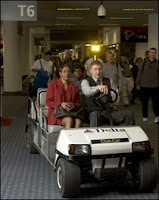
Me: Um, well, you see, the cart is intended for old people.

Ellie (wholly unconvinced by my answer): You’re old.

This was going to be a long trip.

Once airborne, I was horrified to discover that all of Ellie’s electronic toys (portable DVD player, Leapster, etc.), all of which were virtually guaranteed to keep her occupied for hours on end, had no battery power. So, the next 3.5 hours consisted primarily of trying to entertain her and, naturally, placating her rigorous food demands:

Me: Okay, Ellie, here’s the lunch that the nice lady brought for us.

Ellie: What is it, Ca-tin?

Me: That’s a very good question. I think maybe it’s a sandwich. A chicken sandwich.

Ellie: I don’t want it. It’s yucky.

Me (desperate): Well, how about this brownie? Will you eat this?

Ellie: Yeah. That’s yummy!

Me (quite relieved): Okay then. Well then you can take mine and I’ll ask the flight attendant to bring you another.

Ellie: That’s three brownies (She held up three fingers to make sure I understood the gravity of the situation.)! Okay, but you can’t tell Daddy that I had three brownies, or I’ll get in trouble.

Me: There are going to be lots of things we don’t tell Daddy, Ellie.

Later, we arrived at the beach house, where Ellie issued a rather novel request:

Ellie: Ca-tin! I need to go potty.

Me (putting on my bravest face): Okay! You bet! I’ll bet you’re really good at tha…

Ellie (interrupting me): Yeah. I am.

Me: Right. So, do you need to go Number 1 or Number 2?

Ellie: Number 3.

Me (after a pregnant pause): Um, do you have some orifice I don’t know about? Your Mommy and Daddy really should have included that in the briefing. What’s a Number 3?

Ellie: That’s when you go Number 1 and Number 2!

Me (intrigued and rather bemused): Oh, I see. Do you have to go Number 1, then Number 2, or do you go Number 2 first?

Ellie (rolling her eyes): It doesn’t matter, Ca-tin.

Me (trying to engage her in spite of the questionable conversation matter): Oh, I see. Well, what if you go Number 1, then Number 2, then Number 1? Is that a Number 4?

Ellie (clearly losing patience with my inane questions): No, Ca-tin. That’s yucky.

Me: Right. Sorry.

Ellie: That’s okay. I forgive you.

Monday, December 10, 2007

Adventure Tourism for Lazy People

Costa Rica is renowned as a destination for dedicated adventure tourists, eco-tourists, and what I call “pre-extradition” tourists (You’ll find a great many Americans of questionable repute in Costa Rica. These people really don’t merit further discussion.). Apparently, it’s also become a top destination for sex tourism, which now accounts for approximately 10% of all tourism in Costa Rica. By my reckoning, however, the sex tourists should be included in the last category I described above. Honestly, it’s only a matter of time before these people gather together enough money for airfare to Thailand and get themselves into some real trouble. Well, enough of this...

So, Costa Rica is indeed known as a hot-spot for people who crave a bit of adventure tourism or eco-tourism; within this small country, one can pick from seemingly countless varieties of canopy tours, marine activities, and rainforest tours. Costa Rica is also known as a hot-spot for people who like to sweat; thanks to year-round tropical temperatures and truly intimidating levels of humidity, one can enjoy countless hours of sweaty discomfort.

This was my third trip to Costa Rica, so I’d already ticked most of Costa Rica’s offerings off my Costa Rica Adventure Tourism “to-do” list. Additionally, I was in need of a bit of rest after an unusually hectic busy season at work. Taken together, these two factors meant that I would be enjoying a rather lazy adventure holiday in Costa Rica. So, my week of lazy adventure tourism consisted of the following adventures:

Adventure One: This consisted of a bit of waterfall rappelling (that's abseiling, jumping, snapling, and rappling to my British, Australian, Israeli, and Indian friends, respectively). Whatever your nomenclature, waterfall rappelling is where you tie a series of ropes around your junk, and then dangle your body (using said ropes) over a 100 foot (30 m) waterfall. You then descend the waterfall by clumsily loosening the rope. On occasion, you lose your footing and your body slams against the rocks behind the falling water. If you manage to descend the waterfall without injuring yourself, you’ve done something wrong, so you’ll need to climb back up and make another go at it.

Oddly, this activity (the dangling one's body part) wasn't the most adventurous part of the day. Rather, it was the 1.5 hour journey along (extremely) unpaved roads aboard a 4x4 "taxi" that was piloted by our ominously-named driver, “Kamikaze.” I’m pleased to report that I arrived alive.

We had a local guide for the day that was astonishingly well-informed regarding the flora and fauna of the rainforest. As we made the short walk to the waterfall, he'd often reach down, grab seemingly random weeds, shove them in my face, and then instruct me to eat them. As you might imagine, I was a bit wary at first as I typically don't go about munching on plants in the forest. However, I was delighted when he fed me cilantro, cinnamon, rhubarb, and a variety of other delicious plants. By the end of the tour, he had to stop me from grazing on the weeds as we walked back to our base camp.

Adventure Two: Mid-week, the entire family went on a mangrove tour. That's where tourists pile onto a boat and explore the tidal mangrove waterways. With any luck, your boat will include some shockingly rude Canadians (Who knew there was such a thing as rude Canadians?) who insult the tour guide, suggest drowning fellow passengers, and subsequently get tossed off the boat due to their poor behavior. My tour included two such passengers.

Once the Canadians had taken their leave, the mangrove tour was great fun. As we puttered slowly through the brackish inland waterways, we saw several exotic birds, marine creatures, and several troops of white-faced monkeys and squirrel monkeys (Note: A “troop” is a group of monkeys. Add that to your trivia inventory upstairs.) Oh, and we also drank some beer.

Adventure Three: The entire family hired a private guide (after extensive haggling to agree on a price) for a tour of Manuel Antonio National Park, which is a rather breath-taking national park that borders the Pacific Ocean near the town of Quepos. There we saw howler monkeys, at least one caiman, two sloths, too many large lizards to mention, and several other animals. I enjoyed the tour almost as much as I enjoyed not getting bitten by one of many venomous snakes that slither within the national park.

Adventure Four: My dad chartered a rather brightly-colored boat ("The Pink Panther") to take us swimming and snorkeling along the coast of the national park. Despite my initial reservations about climbing aboard an old boat that doubled as a floating work of copyright infringement, it was surprisingly fun. Once aboard The Pink Panther, we relaxed, took turns almost drowning (see the photo of my dad at left), and ate some entirely palatable seafood. Oh, and we also drank some beer.

Monday, October 29, 2007

Photos from Turkey

My photo album from my Turkish travel adventures is now posted online. Please click here to be directed to the online photo album. Once you see the album, click on a photo to enlarge it. I recommend clicking on the first photo and then progressing through in order by clicking "Next" above each photo.

Sunday, October 28, 2007

I'm delighted to spit this stuff out

Turkey's national candy is called Turkish Delight. Also known as loukoum, this confection is comprised primarily of starch and sugar, and is often flavored with rosewater (Sorry, but I have no idea what that is.) and lemon. Turkish Delight is characterized by a jelly-like and sticky consistency, and is often packaged and eaten in small cubes that are dusted with sugar to prevent sticking. Some types contain small nut pieces, such as pistachio. Further, one out of one Catons agree that it tastes like crap; truly an insult to the senses.

Saturday, October 27, 2007

Everybody get jingoistic with it!

During my first day in Turkey, I was taken aback by the quantity of Turkish national flags that were draped about the city. The city was literally awash with crescent moons. Turkish flags were festooned everywhere I went: hanging from the mosques, flying from everything that even resembled a flag pole, on the side of every large building visible from the Bosphorus, and in nearly every child's hand. While Turkey has a perfectly nice flag, I initially found all this more than a little disconcerting. That red and white flags were plastered to the side of anything stationary seemed - to me, at least - eerily reminiscent of Nazi Germany. And I think we can all agree that the rise of Nazism was not one Western civilization's proudest moments.

Fortunately, I was walking outside Istanbul's famous Blue Mosque one night and found a large banner (which the Turkish government had been kind enough to translate to English). As it would happen, October 29 is Turkey's "Republic Day," which commemorates the formation of the Republic of Turkey (and the dissolution of the Ottoman Empire) on October 29, 1923. This, it turns out, explained the abundance of flags; the Turks were simply celebrating an annual holiday. Well, in that case, break out the flags! Surely there are a few spare square centimeters that don't have one yet...

Friday, October 26, 2007

Invading Istanbul (though I'm not exactly the first to do so)

People have been fighting over the city of Istanbul for centuries: Istanbul has been besieged countless times by invading armies and has served as the capital of the Roman Empire (330-395), the Byzantine Empire (395-1204 and 1261-1453), the Latin Empire (1204-1261), and the Ottoman Empire (1453-1922). During this time, the city has gone through more name changes than Jackie Kennedy. Since 667 BC, the city has had at least ten monikers, the most famous of which include Byzantium, Constantinople, Stamboul, and, naturally, Istanbul. Interestingly, Istanbul prides itself as the only major city to straddle two continents. The city is bisected by the Bosphorus Strait, which may resemble a river to the untrained eye. The Bosphorus, however, is a narrow strip of water that connects two seas – the Mediterranean Sea (via the Sea of Marmara) and the Black Sea. The eastern side of the city is called the “Asian” side, while the western side is the “European” side.

Istanbul straddles the East and the West not only geographically, but culturally as well. Despite its rather tumultuous history, Istanbul seems to have extracted the best that every passing culture had to offer and has subsequently incorporated these good bits into its own persona. The shopping areas, for instance, boast a distinctively European flair; I was reminded that I was in a Muslim city only when the city’s 2,000 mosques emitted their regular (and cacophonous) calls to prayer. Istanbul is not, however, just a city of mosques (many of which are architectural masterpieces); you can also find churches and synagogues. Even better, nobody seems the least bit interested in blowing any of them up.

And, while you’re enjoying not getting blown up, you can explore a captivating city. If you're a shopper, you'll love the fact that Istanbul is awash with (sometimes aggressive) vendors of Oriental rugs and other decorative arts (So I’m told. I didn’t devote even one moment to shopping during my visit.). You can also toss back some of the most delicious food you’ll ever encounter (Turkish food is quite similar to most other Mediterranean foods, so it’s heavy on olive oil, chickpeas, lamb, and such. That said, the Turks seem to have devised a method to make these simple ingredients taste better than most other Mediterranean cooks.) The streets (particularly on the European side of the city) are spotlessly clean, the architecture is breathtaking, and, if you visit during October (as I did), you’ll enjoy sublime weather.

In short, it’s easy to see why everyone’s been bickering over Istanbul for centuries; the place is fantastic. If you’ve ever considered visiting Istanbul, I’ve got a bit of advice for you: do.

Thursday, October 25, 2007

Photos from Greece

My photo album from my Greek travel adventures is now posted online. Please click here to be directed to the online photo album. Once you see the album, click on a photo to enlarge it. I recommend clicking on the first photo and then progressing through in order by clicking "Next" above each photo.

Wednesday, October 24, 2007

I flew 6,000 miles for this?

I'm beginning to think that the writers at The Onion had it right in their analysis of Greece: "Ancient Greece was the birthplace of art, science, democracy, medicine, and philosophy. Today, however, the nation has more important things to do than contribute to the advancement of the human race."

If you've ever considered visiting Athens, I've got a bit of advice for you: don't. If you must, ensure that you've included Athens only as part of a much broader itinerary (I hear the Greek isles are lovely, but the resorts were mostly closed during my visit in October.).

"Now Caton," you say, "what's so bad about Athens?" Well, I'll tell you. Put simply, there's almost nothing to do. On the first morning, for instance, we left our hotel full of energy and wonder, ready to tackle this new city. So, we walked to the Acropolis (If you're keen to be particular, it should actually be called "The Acropolis of Athens" since it's one of many such sites. In ancient times, the Greeks typically built an acropolis - the word literally means "high city" - in all key cities, so the Acropolis at Athens was by no means the only acropolis. It was one of many acropoleis.), climbed to the top, ooh'd and ahh'd at the ruins (This took all of one hour. The Acropolis is surprisingly diminuitive.), then walked back down for a long lunch (The fact that the lunch was long had nothing to do with our personal preferences and everything to do with Greek notions of table service.)

Afterwards, we visited an ancient bathhouse just outside the Acropolis, where I received a tongue-lashing from the guards (To be fair, I probably deserved it; I was climbing on a bit of the ruins as if it were a jungle gym, but at least somebody was having fun.). This second "national treasure" took 15 minutes to explore.

Unimpressed, we then walked over to the Temple of Olympian Zeus, which consisted of: (1) some admittedly impressive Greek columns standing in a field; (2) a lawn with no grass; and (3) a surprising quantity of "Do Not Touch" placards. It's as if they were daring me to touch something. I resisted (mostly), for the entire 20 minutes we spent there.

And that was it. After a scant four hours of touring Athens – the majority of which were spent awaiting a Greek salad – we had seen the wonders of Athens. I looked over my map in desperation – surely I had missed some ancient wonder that we had yet to see – but no; we were indeed finished. I turned to Drea, who appeared similarly puzzled:

Me: Well, we're done. But we've we got six more days to burn. And I'm not so sure that I want to spend them here.

Drea: Me neither. This place reminds me of Matamoros (Matamoros is an infamously unattractive border town just across the border from Brownsville, Texas.), except dirtier.

Fortunately, I'm not the type of person to let one bad decision ruin a vacation, so I proposed a change to the itinerary:

Me: How about Istanbul? It's a quick flight over. Let's go there.

Drea: Istanbul? Are you sure that's safe?

Me (I had no idea whether or not Istanbul was safe): Of course it's safe! It's like Disneyland, but with mosques. Oh, that, and the occasional holy war, but they haven't had one of those in quite some time now. The Christian crusaders and the Muslims eventually tired of fighting and they've kissed and made up for the time being.

Drea: Well, okay.

Me: Sweet!

So, we went back to the hotel's internet café, booked a flight to Istanbul online, and woke up the next morning at 5 to catch a flight aboard Olympic Airlines – Greece's national airline – to Istanbul.

Tuesday, October 23, 2007

KLM helps me to "travel light."

After a somewhat arduous journey to Athens (Note: If you ever fly via Continental’s hub at Newark, you will encounter delays. Thanks to one inexplicably cancelled flight, two delayed flights, and a broken jetway, we were forced to take a rather circuitous route to Athens, complete with an unplanned stop in Amsterdam. Amsterdam’s Schipol airport, by the way, was a monument to efficiency and modernity. So, kudos to the Dutch for their airport.), we immediately set to getting ripped off by the local taxi drivers (Well, this was after we spent an hour submitting claims for our lost luggage to the airline, but that’s another matter).

After a long and expensive taxi ride into the city center, we dropped off our hand luggage at the hotel (You’ll recall that our actual luggage had not yet arrived. This confused the taxi driver to no end; since we didn’t resemble the typical American tourist with loads of luggage, he couldn’t decide to which degree we should be ripped off.) and headed out for a meal. After getting lost repeatedly (My keen sense of direction is no match for the mess of streets known as Athens.), we finally found a suitably overpriced restaurant in an area filled with other tourists, and settled down for a much-deserved meal. I ordered moussaka, a traditional Greek casserole consisting primarily of ground/minced beef and eggplant, and Drea enjoyed a bit of spanakopita, which is little more than a puff pastry filled with spinach and cheese, though it is, admittedly, delicious. After a rather long dinner (Invariably, I found table service in Greece to be slow to a truly shocking degree; I once waited 90 minutes for a lunch that consisted of nothing more than a Greek salad.), we trudged back to the hotel for some well-earned rest.

Wednesday, October 10, 2007

I Need a Vacation

Note: As many of you will be keen to point out, my “Round the World” travel didn’t officially commence until December 29, when I took off for Peru. That said, my decision to undertake a global journey was cemented (though perhaps not known to others) by August 2007. Therefore, I’ve decided to include all travels after August 2007 in this travelogue. If this is unsuitable to you, please send me an email detailing your grievances, which I will promptly ignore.

I needed a vacation. After reviewing my calendar, I realized in August 2007 that I hadn’t take a real vacation (i.e., more than two consecutive days away from work) in at least 10 months. Fortunately, due to extensive business travel around the world, I’d amassed an impressive arsenal of Continental OnePass miles, so this journey could be completed at minimal cost. So, during a brief visit to my Dad’s house in August, I called up my friend Drea to see if she’d like to go on vacation with me. The conversation went a bit like this:

Me: “Hi Drea! How are things?”

Drea: “Oh, hey. How are you?”

Me (ignoring her question): You haven’t been on vacation in a good while, right? I didn’t wait for her to answer. So, I think you should join me on my next vacation.

Drea: Um, okay. Where are you going?

Me: Well, I haven’t planned that yet. But I’m pulling up the Continental Airlines route map on the Internet. Okay, here it is. Oh yes! Let’s go to Buenos Aires!

Drea: I’ve never been all that interested in South America.

Me: What? Your name is Andrea Garza! Your grandparents didn’t even speak English and were immigrants from Mexico. How can you not be interested in your own culture?

Drea: Right. My family is of Mexican descent. That’s got nothing to do with Argentina.

Me: Well, I know, but I was hoping that I could sway you with my mock indignation.

Drea: Nope. But good try.

Me: Thanks. Well, fine then. Okay, I’m looking at the map now. The weather will be awful in October, so let’s nix the UK. Studied abroad in Spain, so that’s out…”

Drea: I’ve never been to Paris. I’ve always wanted to go there…

Me (ignoring Drea again as I continue to think aloud): So, that eliminates all of western Europe. Oh! It says here that Continental just began service to Athens. I’ve never been there. How about Greece? We can look at loads of old stuff there. You were a History major; you love old stuff!

Drea (by now rather bemused): Okay. That sounds fine.

Me: Done deal.

And that was that. On October 10, 2007, I was off for Athens.